Showing posts with label Russia. Show all posts

Tuesday, August 12, 2008

21st Century Pot Decries 19th Century Kettle

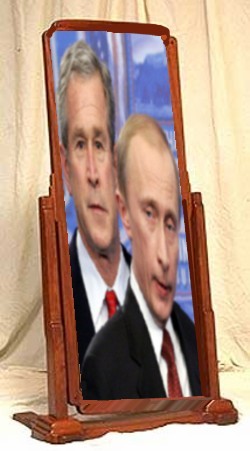
(BTW, that's Robert Kagan's face)

Robert Siegel offers place of honor to the historian-war monger Robert Kagan's rubbish that the WaPo sadly saw fit to print. Siegel, with gravitas, states,
"The historian Robert Kagan writes this today in the Washington Post about the Russian attack in Georgia : 'Historians,' he writes, 'will come to view August 8, 2008 as a turning point no less significant than November 9, 1989 when the Berlin Wall fell. Russia's attack on sovereign Georgian territory marked the official return of history, indeed to an almost 19th century style of great power competition complete with virulent nationalisms, battles for resources, struggles over spheres of influence and territory, and even - though it shocks our 21st century sensibilities - the use of military power to obtain geopolitical objectives.' "
Poor Kagan can't even get his dates right. You don't have to sympathize with Russia's actions to note that the attacks of August 8th were launched not by Russia, but Georgia. And you don't need more sense than a fool to note that there is this other country in the world that - every now and then - likes to throw its military might around to "obtain geopolitical objectives." What a sad reflection on US academe that Dr. Kagan is what Yale and Harvard churn out (of course nothing new there, really).

Siegel's interview with Kagan only gets more ludicrous. Jumping on the Russia-as-Nazi-threat invocation that is sweeping the Homeland (e.g. see NYT, WSJ, and Newsweek ), Siegel notes,
"You invoke a chilling analogy: Russia...is like Germany after WWI....Not to belabor the analogy too much, as you would say, in the 1930s the US, Britain and France have been faulted by historians for failing to contain similar ambitions of Nazi Germany - what should those same countries and the rest of western Europe be doing now to confront Russia?"
Funny, but I just don't recall Siegel or NPR raising concerns about how to confront naked aggression during all those birth pangs in Lebanon just 2 short years ago!

If you read any of the Russia-as-Nazi-threat pieces cited above, it's interesting to note how the 19th century vs. 21st century meme gets worked into their "logic." Of course, in these pieces the US is the hip and with-it 21st century power, while Russia is the 19th century bad boy. The concept even crops up in the Decider's remarks: "Such an action is unacceptable in the 21st century...." I guess the Lord intervened to put the invasion of Afghanistan and Iraq in a special non-21st century exemption zone so that the US could never be slandered with the accusation of being - OMG - 19th century!

Wednesday, April 02, 2008

Set It Up Nicely

As our pipsqueak of a President talks big at the NATO summit NPR is there to help our little tyrant shine his "legacy." As Bush pushes for greater NATO expansion, a thinking person might judge this a good time to question the policy of US/NATO triumphalism and aggressive expansion. Way back in 1998 the "No to NATO expansion Speakers Tour" managed to find a range of critics. Stephen F. Cohen has noted how the US/NATO post Cold War policy represents a tragic, lost opportunity, and in a 2006 article in The Nation he writes,
"The real US policy has been very different--a relentless, winner-take-all exploitation of Russia's post-1991 weakness. Accompanied by broken American promises, condescending lectures and demands for unilateral concessions, it has been even more aggressive and uncompromising than was Washington's approach to Soviet Communist Russia."
Mark Ames, a US reporter living in Russia has also noted the dangers of the US/NATO divide and conquer strategy toward Russia.

On the NPR piece we get to hear plenty from the decider:
  • "NATO should welcome Georgia and Ukraine into the membership action plan, and NATO membership must remain open to all of Europe's democracies that seek it."
  • "I will reiterate that the missile defense capabilities we are developing are not designed to defend against Russia — just as the new NATO we are building is not designed to defend against Russia. The Cold War is over. Russia is not our enemy."
And then for analysis, where does NPR turn? Why, former U.S. ambassador to NATO Robert Hunter! Now that is some daring journalism! I hope Michele Kelemen gets her medal; she tells us that "as for the President's speech, Hunter gives him high marks for recognizing NATO's importance at his last summit of the alliance." And then we get to hear the great Hunter himself:
"The rest of the world is looking to American leadership, and I think he set it up very nicely for the next President — whichever of the three becomes president — because they're going to have a lot of work to do in common."
All's well in the empire...

Wednesday, December 19, 2007

A Lloyd Bentsen Moment Perhaps

On ATC tonight Melissa Block talks to Time magazine's managing editor Richard Stengel about the decision to name Vladimir Putin Time's Person of the Year. We get to hear Block describe "the icy, impassive eyes" of Putin on the magazine's cover. Later in the interview Stengel says, "you know the person who Putin could end up being like, Josef Stalin, was person of the year twice."

Okay. Hold it! Reality check needed. I really wanted Block to say, "Mr. Stengel, we know about the millions that Stalin murdered, and Putin is no Josef Stalin!" Alas, such correctives were not forthcoming. If this were an isolated event, I'd pass it off to a bit of careless hyperbole, but it fits the pattern of NPR carelessly exaggerating foes of the US establishment (Chavez, Castro, Ahmadinejad, etc.), while glossing over the grotesque faults of our own leaders and "friends." Funny, I don't recall NPR talking about Putin's icy eyes when Bush was covering for his carnage in Chechnya. Look, Putin is no friend of democracy; I know that, but comparing him to Stalin....give me a break.

Tuesday, October 16, 2007

Let's Look in the Hoover...Again


So Putin is visiting Iran. I wonder where NPR might turn for a little insight on this...I know, how about another far right think tank - how novel!

How stupid does Mike Shuster and NPR think you are? Well, consider this little nugget of expert analysis about Russia and Iran from Michael McFaul of the rightwing Hoover Institution (see this entry from PFAW):


"Both countries have very rather difficult relationships with the West right now because of the way that they organize their regimes, neither are considered by western standards to be democracies."

See, it has nothing to do with all of our oil and natural gas that Iran and Russia happen to be sitting on. No it's that they are not democracies - and we all know how the US deals with authoritarian dictatorships.

Sunday, October 14, 2007

Condi's Mouth

Two extremely important events involving the US Secretary of State, Condoleezza Rice - her trip to Russia to push for US military expansion into Poland and the Czech Republic and her maneuvers in Jerusalem with Abbas and Olmert to supposedly push for "peace" between Israel and the Palestinians. Guess what expert we get from NPR to provide background and analysis? The dutiful Michele Kelemen who has repeatedly shown herself to be a mouthpiece for Rice (e.g. January 2007 and July 2006). Kelemen has NO expertise on the Middle East and offers no significant information on why Rice is a completely discredited agent for such efforts. Listening to Kelemen, you'd never know that the consistent thrust of the Bush administration has been to undermine any and all efforts at finding a just peace between Israel and the Palestinians.

On the bogus "need" for missile defense in Eastern Europe and Russia's understandable suspicions of this US policy, we get nothing from Kelemen. Would have been a good opportunity to interview to some experts who dissent from the pro-administration line - Katrina Vanden Heuvel, Stephen Cohen, or Anatol Lieven. Anything with substance, instead of the empty parroting of Kelemen.

Sunday, June 03, 2007

Constraints

This morning I had to wake up to Liane Hansen saying, "...this week Putin criticized the United States for what he called imperialism [Hansen’s emphasis] in global affairs, and he said, and I’m going to quote, 'It wasn’t us that initiated a new round of the arms race.' What do you make of that tone?"

Her tone is what struck me. She said imperialism very slowly and with utter disdain - as if the term was nothing but jingoistic nonsense. That's interesting because you have to be a fool or liar to deny that the concept of the US as an empire is taken very seriously by people of many political viewpoints. If the US government does not hold imperial ambitions then how does one explain these statements of the official 2002 US National Security Strategy:
  • To contend with uncertainty and to meet the many security challenges we face, the United States will require bases and stations within and beyond Western Europe and Northeast Asia, as well as temporary access arrangements for the long-distance deployment of U.S. forces.
  • Our forces will be strong enough to dissuade potential adversaries from pursuing a military build-up in hopes of surpassing, or equaling, the power of the United States.
  • We will take the actions necessary to ensure that our efforts...are not impaired by the potential for investigations, inquiry, or prosecution by the International Criminal Court (ICC), whose jurisdiction does not extend to Americans and which we do not accept.
And from whom was Hansen seeking insight on this claim of American imperialism? From the fear-mongering Thomas Pickering, a loyal soldier of US global power who has served Henry Kissinger, Ronald Reagan, and George H. W. Bush (Pickering was also, notoriously, ambassador to El Salvador).

Don't get me wrong, I don't mind hearing from such establishment players on NPR , but why is there never any serious counter-perspective? Why don't we hear about Russia from experts like Craig Murray, who also has the dirt on the US-British behavior. Or why not bring on critics of US imperialism such as Chalmers Johnson or Noam Chomsky?

It seems plainly obvious that NPR tightly restricts the limits of what is considered acceptable for debate. Those limits are based in an unquestioning faith in the overall goodness of American power and policy, regardless of any and all evidence that might undermine that faith. It's enough to drive someone crazy...

Monday, March 05, 2007

Cute Little Eagle and The Big Bad Bear

The host (Michelle Norris or Melissa Block) of ATC introduces the story on Russia's new assertiveness by stating, "Fifteen years after the collapse of what President Reagan called 'the Evil Empire,' the Russian bear is growling again...." She's not being facetious!

Gregory Feifer then picks up the ball and runs with it. We hear that "Russia's new aggressiveness was also starkly evident at a recent defense and security conference in Munich. President Vladimir Putin shocked the West by lashing out against Washington, helping to plunge relations between the United States and Russia to their lowest level since the Cold War." Now, what was the "new aggressiveness?" Did Russia preemptively invade a country, back a coup in South America, or threaten to use "bunker busting" nukes?

According to NPR, what Putin said was, "One state's rule has overstepped its national borders in all areas, in economics, politics and the humanitarian sphere, and is trying to force itself on other states--well, who would like that?" Those are the words that NPR labels as aggressive and lashing out; that's odd - to me they sound like stating the obvious.

Feifer then turns to Sarah Mendelson of the Center for Strategic and International Studies, pro-US government think tank, for input on Russia. According to Feifer, Mendelson claims that Russia "has reverted to Soviet-style obstructionism in international forums, such as the United Nations Security Council, where Russia has veto power."

Mendelson claims that "Time and time and time again, the Russians are voting with the Chinese on a variety of issues, often having to do with human rights, that are simply meant to put a spoke in the wheel as the international community is trying to do something about gross human-rights violations. And that is very much a legacy of the Soviet Union, and it's very disturbing." Not like the US, which never obstructs international consensus on the Israel-Palestine issue, or on Kyoto, or on the International Criminal Court, or on the Land Mine Treaty, or....

Really the only offense one can lay at Russia in this story is that they have dared to name the policy of global domination that underlies US foreign policy. You don't exactly have to have a full deck to come to that conclusion! Furthermore, I've commented before how whenever NPR covers Russia, its reporters show a perverse inability to see how much the faults they find with Russia mirror those in the US. A choice moment in this story comes when Feifer cites Nemtsov, a Russian pro-Western reformer, who says that "Putin and his allies think other countries are run just like Russia, and that in a powerful country like the United States, the government must have control of the judicial system and the media."

Nemtsov says, "No independent court system, no opposition, no independence of press. This is special cynical game against Russia. He [Putin] believes in that.’ Gee what could possibly lead Putin to think that the US has a weakened judiciary, a lapdog press, and a pseudo-opposition party? Those crazy Russians!

Wednesday, November 29, 2006

The Russian Mirror

There is something about the subject of Russia that causes NPR to create unintended mirror images of our own corrupt government and slovenly mainstream media. On Morning Edition today Renee Montagne interviews David Remnick of the New Yorker about Putin's rollback of democracy in Russia - especially his muzzling of the Russian press. (Oddly, the archived audio link to this story omits quite a bit of what was actually broadcast.)

In the broadcast Remnick tells us, "You can pick up newspapers that seemingly are very lively and are filled all kinds of differing points of views. That's fine, but those newspapers now have minimal circulation, and similar reporting is not allowed on the medium that everyone sees and everybody listens to, and that's television...." The question never raised is, "So how is that different from the US?" Yes, there are very good alternative, lively news sources here in the US, but on the "medium that everyone sees" (or hears in the case of NPR) where are the challenges to the premises of defense spending, military intervention, unrestricted corporatism, etc?

Remnick also says that Russia "..doesn't permit political opposition or real politics. Anytime real politics begins to form, it's snuffed, and it's done rather easily, and all in the interest of stability...." Couldn't the same be said of third parties in the US, or of the manufactured issue of "bipartisanship" within the limited two party system? Such an obvious comment is never raised.

This strange echo of Russian despotism was especially poignant given the other story on Morning Edition about "Benjamin Tupper...an Army National Guard captain embedded with the Afghan National Army." Of Afghanistan, Cpt. Tupper tells us "the installation we call home is built upon the ruins of an old Russian airforce base." Ah yes, the Russian nightmare of Afghanistan, seems like just yesterday, and the soul of the Russian despot seems awfully familiar--ghosts and reflections.

Friday, October 20, 2006

Quiz Time!

All right students, read the following clues and then decide what country is being described:
  1. The president of this country "mouths the words, but the concepts - I fear - escape him."
  2. "It's a corporate state."
  3. In this country there is "a marriage between these corporate entities and the state."
a) The United States
b) Russia

Let's see a show of hands for those who picked the United States. Were you thinking of Bush, Halliburton, Cheney, Exxon, General Electric? Hold on, here's one more clue. When the president of this country came to power "over 30% of the population was under the poverty line; now it’s down to about 17%, 18%."

That does eliminate the US, doesn't it. The correct answer is Russia!

It was laughable on NPR's ATC to hear emminent scholar Marshall Goldman saying so many things about Russia without any sense of how close to home his comments were. There was one striking comment in which Goldman stated that in Russia, "the corporate state," corporations do what the state tells them to do. I couldn't help but think, yes, and in the US the state does what corporations tell them--pick your poison.

It really is sad how debased intellectuals in this country can be. In the beginning of the report Goldman says, "the National Democratic Institute and the International Republican Institute which are funded actually by the US Government and whose purpose is to increase democracy and political participation all over the world." That a scholar could say something so incredibly biased, naive, and untrue is stunning.